
Back homeLayan Faraj

The Archieve of AUDINTRA

Audintra: designing what happens between the records

With Audintra, I’m interested in a problem that can remain even when an organisation has documented its work carefully: how does someone know whether those documents still describe what is happening?

A requirement may have an owner and a supporting procedure, yet that tells us little about whether the procedure is being followed or whether the available evidence still applies. I wanted to explore how software could help people follow those relationships closely enough to recognise where attention is needed.
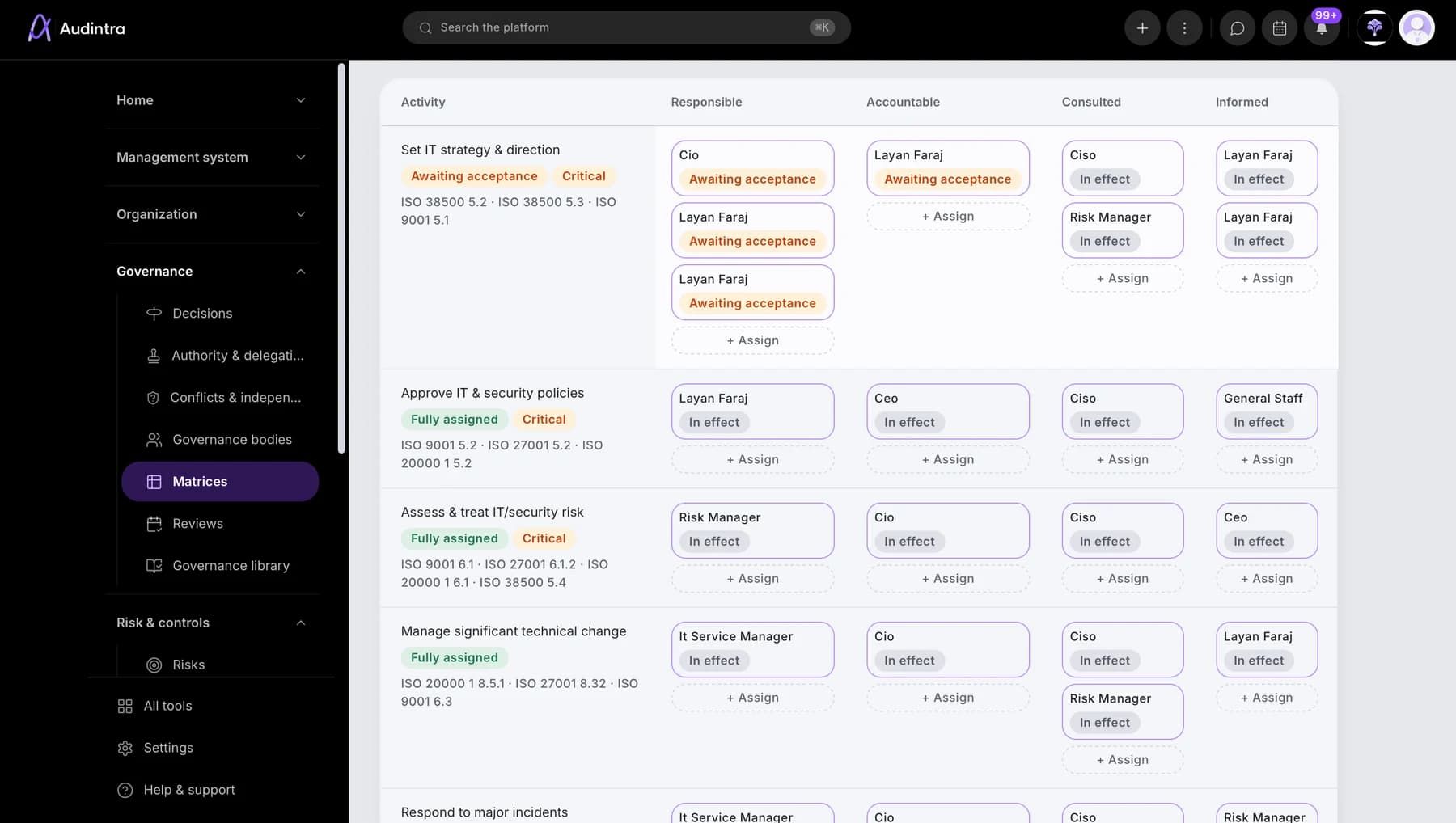
Audintra governance responsibility and accountability matrix from the app gallery
Responsibility & accountability / app record

That is the direction I am developing Audintra around, as an integrated management system connecting formal requirements with the work that fulfils them. The ambition is substantial, but the design question becomes quite concrete when I consider what happens to one requirement over time.

Suppose a requirement changes after a control has been assessed. The previous assessment remains a record of what was examined, but its relevance to the revised requirement now needs consideration. I would want the system to make that relationship visible so the responsible person could decide what needs reviewing. Automatically carrying forward a reassuring status could conceal the very uncertainty the system should help expose.
Layan Faraj1

Audintra: designing what happens between the records

With Audintra, I’m interested in a problem that can remain even when an organisation has documented its work carefully: how does someone know whether those documents still describe what is happening?

A requirement may have an owner and a supporting procedure, yet that tells us little about whether the procedure is being followed or whether the available evidence still applies. I wanted to explore how software could help people follow those relationships closely enough to recognise where attention is needed.

Audintra governance responsibility and accountability matrix from the app gallery
Responsibility & accountability / app record

That is the direction I am developing Audintra around, as an integrated management system connecting formal requirements with the work that fulfils them. The ambition is substantial, but the design question becomes quite concrete when I consider what happens to one requirement over time.

Suppose a requirement changes after a control has been assessed. The previous assessment remains a record of what was examined, but its relevance to the revised requirement now needs consideration. I would want the system to make that relationship visible so the responsible person could decide what needs reviewing. Automatically carrying forward a reassuring status could conceal the very uncertainty the system should help expose.

Layan Faraj1

Page 1 of 3

Page 1 of 3: Page 1